Match the glue to the two materials you’re joining. Tacky glue and decoupage medium suit paper, wood and other porous pieces. Fabric glue is made for cloth. Hot glue, E6000, super glue and epoxy reach glass, metal and plastic, but every maker puts limits on plastic.
Dry is not the same as cured. Some glues need a day, and Mod Podge needs about four weeks.
| Glue | Paper | Fabric | Wood | Glass | Metal | Plastic |
|---|---|---|---|---|---|---|
| Tacky glue | Yes | Limited | Yes | No | Yes | No |
| Fabric glue | No | Yes | No | No | No | No |
| Mod Podge Gloss | Yes | Yes | Yes | No | No | Limited |
| Hot glue | No | Yes | Yes | Yes | Yes | Limited |
| E6000 Craft | No | Yes | Yes | Yes | Yes | Limited |
| Super glue gel | Yes | No | Yes | No | Yes | Limited |
| 5-minute epoxy | No | No | Yes | Yes | Yes | Limited |
From the product pages and data sheets of Aleene’s, Plaid, Gorilla, Eclectic Products (E6000) and Loctite. Yes means the maker lists the material. Limited means it lists it with a condition. No means it isn’t listed or is ruled out.
How do craft glues differ?
Craft glues fall into a few families. Each one sets in its own way, and that decides what it can hold.
White glue and tacky glue
White glue, or school glue, is PVA glue. Aleene’s explains that PVA stands for polyvinyl acetate and that it stays flexible when dry. It bonds as the water in the glue evaporates.
Tacky glue is a thicker PVA glue that grabs on contact. Aleene’s says its Original Tacky Glue works on most surfaces. Its own list is felt, foam, wood, metal, paper products, ceramics and non-washable fabrics.
Fabric glue
Fabric glue is made to bend and survive the washer. Aleene’s says Fabric Fusion bonds fabrics and embellishments to other fabrics and stays flexible after washing. Its list is cotton, denim, flannel, leather, jersey, ribbon and trims, and sequins and beads.
Decoupage medium
Mod Podge is a glue, sealer and finish in one jar. Plaid lists Mod Podge Gloss for tissue paper, wood, fabric, plastic and canvas. It works best on porous surfaces. Plaid says plastic may need light sanding first. The Mod Podge types guide compares the other formulas.
Hot glue
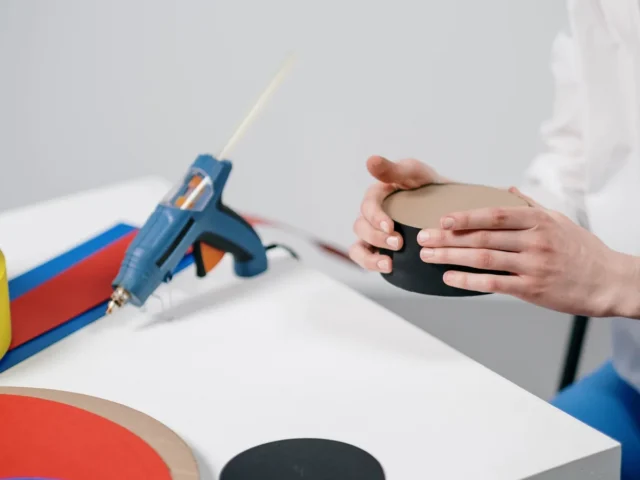
Hot glue comes as solid sticks that a glue gun melts. Gorilla’s sticks list wood, metal, glass, plastic, floral, fabric, leather and foam. They work in high and low temperature guns. Gorilla suggests low heat for delicate floral, fabric and foam work. The low-temp vs high-temp glue gun guide covers the guns themselves.
Multi-surface adhesive such as E6000
E6000 is a thick, flexible adhesive that hardens as its solvent evaporates. Its maker lists wood, metal, glass, fiberglass, ceramics, masonry and concrete, plus leather, rubber, vinyl and many plastics. The same sheet calls it washer and dryer safe.
Super glue
Super glue is cyanoacrylate. Gorilla explains that it needs a little absorbed moisture on the surfaces to cure. Its Super Glue Gel lists wood, metal, ceramic, rubber, leather, paper, stone and plastic.
Two-part epoxy
Epoxy comes as a resin and a hardener that cure once mixed. Loctite’s Epoxy Clear is for tile, wood, metal, ceramic, glass and most plastics. Loctite says it also works as a gap filler. Gorilla rates its super glue gel as not gap filling.
Which glue works on which material?
Start with the harder of your two materials. The table above shows what each maker lists. For porous materials, the lists look like this:
- Paper: tacky glue, Mod Podge Gloss and Gorilla Super Glue Gel. E6000’s maker rules out paper products.
- Fabric: fabric glue first. Gorilla’s hot glue lists fabric, and E6000’s data sheet includes fabric in its adhesion tests. Aleene’s limits its tacky glue to non-washable fabrics.
- Wood: every glue here except fabric glue.
Hard, smooth materials narrow the field:
- Glass: hot glue, E6000 and epoxy. For decoupage on glass, Plaid points to its Dishwasher Safe and Multi-Surface formulas rather than Gloss.
- Metal: tacky glue, hot glue, E6000, super glue gel and epoxy.
- Plastic: nearly always limited. The next section explains why.
Why is plastic always limited?
Some plastics barely take glue at all. Gorilla rules out polyethylene and polypropylene for its hot glue, super glue and epoxy. Its super glue page explains that these plastics have little or no moisture, so they “will not form good bonds”.
E6000’s maker rules out the same two and adds polystyrene and Styrofoam. Loctite says “most plastics” without naming the exceptions. If the plastic type is unknown, the makers’ own advice is to test first.
Do makers agree on the same material?
Mostly, but the lists differ even within one brand. Gorilla names glass for its hot glue and epoxy, but not its super glue gel. So read the list for the exact product. Aleene’s says to “always test for best results.” E6000’s maker says to test a small area first.
How long does craft glue take to dry and cure?
Dry means the glue has set enough to handle. Cured means it has reached full strength. The two can be hours or weeks apart.
| Glue | Dry or set, as stated | Full cure or wait, as stated | Washing and outdoors |
|---|---|---|---|
| Aleene’s Original Tacky Glue | 37-47 minutes for a 3 mm coat at 70-73°F | Aleene’s rule for white glues: overnight, or 48 hours if the bond bears weight | Listed for non-washable fabrics only |
| Aleene’s Fabric Fusion | 24-30 minutes for a 3 mm coat | “Let dry 2-4 hours to fully cure”; washable after 48 hours | Machine wash inside out on gentle; low-heat dryer |
| Mod Podge Gloss | Touch dry in 15-20 minutes (Plaid FAQ) or 20-30 minutes for thin coats (Plaid Help) | About 28 days | Not waterproof; Outdoor formula is for covered spots |
| Gorilla Hot Glue Sticks | 45 seconds of working time | Not stated | Outdoor use yes; not for constant water |
| E6000 Craft | Tacky in about 2 minutes; sets in 45 minutes | 24 hours for a thin film; 48-72 hours for a thick one | Washer and dryer safe; paint it for UV resistance |
| Gorilla Super Glue Gel | 10-45 seconds | Not stated | Not for outdoors |
| Loctite Epoxy Clear | Sets in 5 minutes | Fully cures in 24 hours | Resists humidity and water |
A dash means the maker doesn’t state it.
The tacky glue figures come from Aleene’s product page and its glue guide. Aleene’s adds that set glue “does not always mean that it is completely dry.” On wood or pottery, it says to clamp or weight the pieces for 30-40 minutes.
Plaid gives two touch-dry times. Its product page says 15 to 20 minutes, and its help center says 20 to 30 minutes for thin coats. The help center also says to handle pieces gently for the first 24 hours. For the cure, Plaid’s FAQ says about 28 days, with little handling and no water during that time.
E6000’s craft data sheet says to let both coated sides sit about 2 minutes before pressing them together. Its industrial page says that product begins setting in about 10 minutes, so the two products differ. All its figures depend on the material, humidity and temperature. The data sheet gives 50 to 90°F as the ideal working range.
Gorilla says its epoxy must be applied within 5 minutes of mixing, because it keeps thickening. Gorilla doesn’t state a full cure time for it, so the table uses Loctite’s figure.
Which craft glues are washable or safe outdoors?
For clothes, the makers give clear answers. Aleene’s says Fabric Fusion is machine washable after 48 hours. E6000’s maker says its craft glue maintains its bond after washing and drying. Tacky glue is listed only for non-washable fabrics. For painted designs on clothes, see acrylic paint on fabric.
Outdoors, the claims vary. Plaid says Mod Podge is not waterproof, and standing water can leave a cloudy mark that may stay. Mod Podge Outdoor is for sheltered outdoor use. Dishwasher Safe is top-rack safe on glass and ceramics once fully cured.
The other makers rate their glues this way:
- Hot glue: Gorilla rates its sticks for outdoor use, but not constant water.
- E6000: clear E6000 is not formulated for sunlight, so the maker suggests painting over it.
- Super glue: Gorilla’s gel is not for outdoor use.
- Epoxy: Loctite’s resists humidity and water. Gorilla’s is outdoor-rated, but not for constant water.
For painted pieces that will face weather, how to seal acrylic paint covers topcoats. Spray paint for crafts covers outdoor paint jobs.
Plaid, Gorilla and E6000’s maker each say their glue isn’t for food contact. Plaid says to keep Mod Podge off rims and any surface that touches food or the mouth.
Is craft glue safe to use at home?
It depends on the glue. Read the label and the safety data sheet for the exact product. Both are the maker’s own word on what to wear and where to work. The CPSC suggests choosing products with few or no warning labels when that’s possible.
What do the AP and CL seals mean?
ACMI’s AP seal marks products a toxicologist has certified as not toxic or injurious to humans, including children. Plaid says Mod Podge Gloss carries the AP seal. ACMI advises AP products for children in sixth grade or younger, and never CL products for them. A CL seal means the product carries cautionary labeling for known health risks.
Do craft glues give off fumes?
Some do. The EPA lists glues and adhesives among craft sources of VOCs, which can cause eye, nose and throat irritation and headaches. The EPA says to increase ventilation and meet or exceed label precautions. If a label says to work in a well-ventilated area, the EPA suggests going outdoors or using an exhaust fan.
ACMI notes that smell is not a good indicator of toxicity. A sweet or faint smell doesn’t mean a product is safe.
What do the safety data sheets say about E6000 and epoxy?
E6000’s current data sheet names toluene and petroleum distillates as its solvents and marks them flammable. It carries a California warning about toluene and reproductive harm. The maker says to read the hazard information first. The CPSC says to keep open flames and ignition sources away from glues with flammable solvents.
The only E6000 Clear safety data sheet online is dated 2017. It lists tetrachloroethylene, not toluene, so it likely describes an older formula. It warns of skin and eye irritation and calls for gloves, eye protection and ventilation. The maker sends the current sheet on request. The CPSC adds that solvent glues may cause skin and eye irritation.
Gorilla’s epoxy hardener sheet carries the signal word Danger. It says the hardener is harmful in skin contact, may cause an allergic skin reaction and can seriously damage eyes. It calls for gloves and eye protection. Gorilla also says to use its epoxy in a well-ventilated area. The CPSC likewise advises gloves and goggles with glues.
What if super glue bonds skin?
Gorilla’s safety data sheet warns that cyanoacrylate “bonds skin and eyes in seconds”. It also lists skin, eye and breathing irritation. Poison Control says never pull bonded skin apart. Soaking in warm soapy water, acetone or rubbing alcohol can loosen it, though it may take hours.
Poison Control adds that a large amount on skin can cause chemical burns, because curing releases heat. If glue gets in an eye, don’t force it open. Rinse with water for 15 minutes and get help from webPOISONCONTROL or 1-800-222-1222. Gorilla’s first aid page also says to call a poison control center for skin bonding.
Poison Control notes that dry super glue is not toxic. Most school glues are not poisons either. Super glue can still stick lips and eyelids together.
How do you avoid hot glue burns?
Gorilla warns that heated glue and the gun nozzle can reach 400°F. If hot glue lands on skin, it says to plunge the area into cold water and not to pull the glue off while hot. For children, the CPSC advises low-temperature glue guns.
Glue guns themselves can fail. In 2022 the CPSC announced a recall of about 1,025,000 glue guns for fire and burn hazards.
How do you choose the right craft glue?
-
Name both materials
The glue must be listed for both in the chart.
-
Check the plastic
Avoid polyethylene and polypropylene. Test unknown plastic on a scrap.
-
Decide on washing and weather
Only fabric glue and E6000 are rated washable here.
-
Plan the wait
Wait for the full cure before washing or loading it.
-
Read the label
Check the warnings and safety data sheet, and set up airflow first.
If the project ends in paint, acrylic painting for beginners covers the next step.
Sources
- Aleene’s, Original Tacky Glue 16 fl. oz. 3 Pack
- Aleene’s, Learn All About Glue’s History and Interesting Facts
- Aleene’s, Fabric Fusion Permanent Fabric Adhesive
- Plaid, Mod Podge Gloss
- Plaid, Mod Podge Academy
- Plaid, How long does Mod Podge take to cure?
- Plaid Help Center, How long does Mod Podge take to dry and fully cure?
- Gorilla, Gorilla Hot Glue Sticks
- Gorilla, Gorilla Super Glue Gel
- Gorilla, Gorilla Epoxy
- Gorilla, First Aid and SDS: Glues and Adhesives
- Gorilla, Super Glue Gel Safety Data Sheet
- Gorilla, Epoxy Hardener Safety Data Sheet
- Eclectic Products, E6000 Craft Adhesive Technical Data Sheet, Rev 6
- Eclectic Products, E6000 Industrial Adhesive
- Eclectic Products, E-6000 Clear Safety Data Sheet (2017)
- Loctite, Loctite Epoxy Clear Multi-Purpose
- U.S. Consumer Product Safety Commission, Art and Craft Safety Guide
- U.S. Consumer Product Safety Commission, Dollar Tree Recalls More than One Million Hot Glue Guns Due to Fire and Burn Hazards
- Poison Control, Is super glue toxic?
- Poison Control, Safe use of art products
- Art and Creative Materials Institute, Art Materials Safety
- U.S. EPA, Volatile Organic Compounds’ Impact on Indoor Air Quality
Each source was read on November 10, 2026.