A low temp glue gun runs at about 220°F to 250°F on the makers’ figures. It suits foam, lace, ribbon and other delicate materials. A high temp gun runs at about 320°F to 380°F and suits wood, metal, plastic and glass. A dual temp gun switches between the two, and every gun needs sticks of the size its maker lists.
How hot does a low temp glue gun get compared with a high temp one?
Each maker states its own numbers, and they don’t line up exactly.
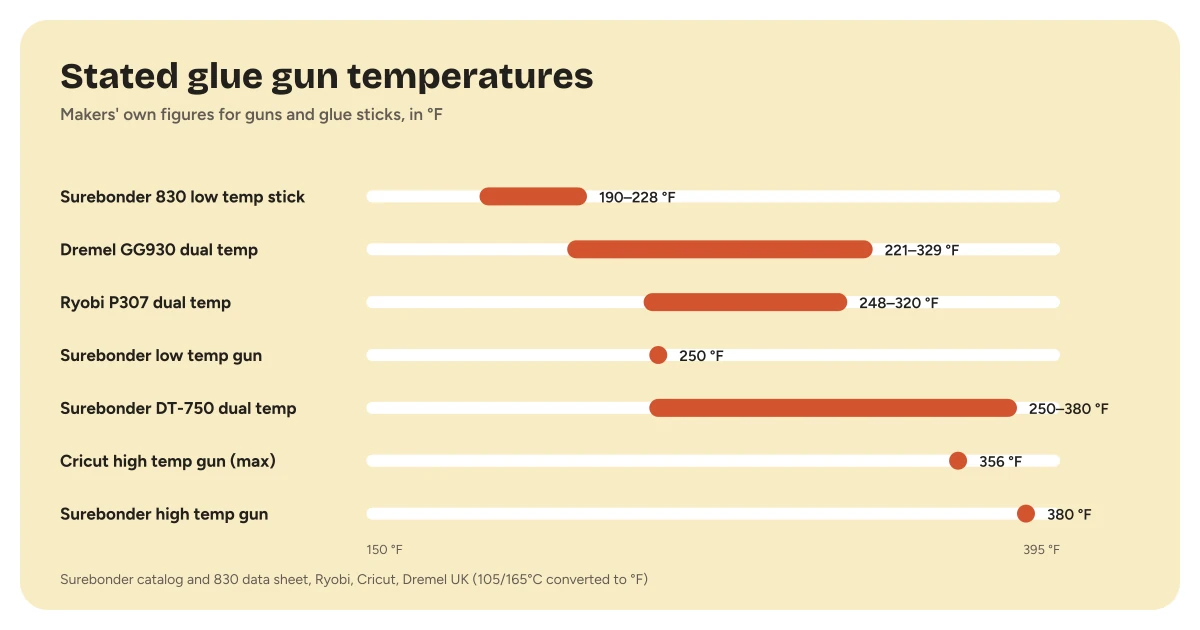
- Surebonder: its low temp gun runs at 250°F and its high temp guns at 380°F (Surebonder catalog). The Cool Shot mini is sold as “ultra-low” at 250°F (Surebonder Cool Shot).
- Gorilla: both of its dual temp guns warn that the nozzle “can reach 380ºF” (Gorilla full size). Gorilla doesn’t state a figure for the low setting.
- Ryobi: the 18V P307 heats to 248°F on low and 320°F on high.
- Cricut: its glue gun is high temp only, with a maximum internal temperature of 356°F.
- Dremel: its UK range lists 105°C for low temp and 165°C for high temp. That is about 221°F and 329°F.
Arrow and Stanley describe high and low settings but give no degrees (Arrow, Stanley).
Glue sticks carry temperatures too. Surebonder’s all-temp formula 725 is applied between 250°F and 380°F. Its low temperature formula 830 is applied at 190°F to 228°F.
So “low temp” is a relative label. It means cooler than the same maker’s high setting. It does not mean cool to the touch. Surebonder, Gorilla and Cricut all warn against touching the nozzle or melted glue.
Which materials suit low temp and which suit high temp?
The makers agree on the broad split. Low heat is for materials that hotter glue could melt or mark. High heat is for a stronger bond on harder materials.
| Maker’s guidance | Low temp | High temp |
|---|---|---|
| Stated temperature | 221°F to 250°F (Dremel, Ryobi, Surebonder) | 320°F to 380°F (Ryobi, Dremel, Cricut, Surebonder, Gorilla) |
| Surebonder DT-270 manual | Lace, foil, ribbon, floral foam, lightweight fabric | Wood, plastic, metal, ceramics, magnets, leather, paper, fabric |
| Gorilla | Floral, fabric, foam, jewelry | Wood, plastic, metal, glass |
| Surebonder 725 stick | Styrofoam, paper, fabric, ribbons | Most plastics and woods |
| Surebonder Cool Shot | Balloons, lace, photos, foam | Not offered (low temp only) |
| Ryobi P307 | Heat-sensitive materials | “Adhesives like construction glue” |
Fabric shows up on both sides. Surebonder puts lightweight fabric on low, and Gorilla lists fabric there too. Surebonder also puts fabric and leather on high. For decorating cloth instead of gluing it, see acrylic paint on fabric.
Cricut’s high temp gun works best on “textured and porous materials, such as paper, fabric, woods, and most plastics.” Gorilla’s sticks are not recommended for polyethylene or polypropylene plastics.
Surebonder’s manuals add one limit for every setting: “Do not use hot melt glue to replace structural fasteners.”
Hot glue isn’t the only choice for paper and flat surfaces. Mod Podge types compares brush-on finishes, and which glue for crafts matches glues to materials.
What size glue sticks fit a glue gun?
Glue guns come in mini and full size, and each size takes its own stick diameter. These are the makers’ figures.
- Mini sticks: Surebonder’s LT-160 mini takes 0.27″ sticks, and so do Gorilla’s minis (Gorilla mini). Gorilla’s FAQ allows 0.27″ to 0.29″. Cricut’s mini sticks measure 0.29″. Surebonder’s catalog lists its small sticks as 5/16″.
- Full-size sticks: Surebonder and Gorilla use 0.43″, which is 7/16″ (Surebonder catalog, Gorilla full size). Ryobi’s P307 and Arrow’s TR400DT take 1/2″ sticks. Surebonder notes that standard 7/16″ sticks fit both 7/16″ and 1/2″ guns.
- Lengths: Surebonder’s catalog lists 4″, 10″ and 15″ full-size sticks and 4″ and 10″ small ones. Gorilla sells 4″ and 8″ sticks in both sizes. Arrow uses 4″ and 10″ sticks. Cricut’s mini sticks are 8″ long, and the ones in its box are 3.9″.
The wrong size causes trouble. Surebonder’s troubleshooting says glue that “backs up at inlet tube” may mean the sticks are the wrong size. Its manuals also say, “Do not use any material other than recommended glue sticks.”
Does the stick’s temperature have to match the gun?
Yes, unless the stick is rated for both. Dremel matches each stick to 105°C or 165°C. It warns that a low temp stick in a high temp gun turns “too liquid” and drips. Colored and glitter sticks can lose their pigment. Stanley allows its DualMelt sticks on both settings but hot-melt formulas on high only.
Dual temp and all-temp sticks cover both settings. Gorilla’s sticks work “in high and low temperature hot glue guns”, and Cricut’s mini sticks are dual temperature. Surebonder’s 725 is made for low, high and dual temp guns. Its data sheet also says “Do Not Mix with other adhesives.”
What does a dual temp glue gun do?
A dual temp gun has a switch for high and low heat, so one tool covers both lists in the table. Surebonder’s DT-750 runs at 250°F on low and 380°F on high. Ryobi’s P307 uses 248°F and 320°F. Dremel’s GG930 offers 105°C and 165°C modes.
The makers use the switch the same way. Low is for delicate pieces like lace and foam. High is for wood, metal, plastic and glass. Gorilla prints both lists on its dual temp guns.
Load sticks rated for both settings, or for the one you plan to use. Gorilla says to use its sticks “per glue gun instructions.” Stanley’s low setting takes only its DualMelt glue.
Give the gun time to heat. Surebonder and Gorilla both say about 5 minutes. Cricut says 3 to 4 minutes, when its light turns green. Surebonder adds that a new gun needs about two sticks to start up.
Is a low temp glue gun safe for kids?
The makers set age limits even for their coolest guns. Surebonder recommends its 250°F Cool Shot for children 12 and up with adult supervision. Cricut says its gun “is intended to be operated by an adult only.” Gorilla says to keep its guns away from children and store them out of reach.
Every setting is hot enough to cause burns. Surebonder’s data sheets warn that “severe burns will result” from contact with molten glue. That applies to its all-temp and low temp formulas alike (725 data sheet, 830 data sheet). In 2022 the CPSC recalled over a million glue guns that could malfunction when plugged in, “posing fire and burn hazards” (CPSC).
A glue gun is on whenever it’s plugged in. Surebonder and Gorilla both say not to leave it unattended (Gorilla). Surebonder’s manuals ask for a clean, dry, well-lit work area, no extension cords, and safety glasses, gloves and long sleeves (Surebonder manuals). Unplug the gun and let it cool before storing it.
What should you do if hot glue gets on your skin?
Hot glue on skin is a heat burn, the hazard named in that CPSC recall (CPSC). These steps follow the American Red Cross, its advisory council’s cooling advice and the glue makers’ instructions.
-
Cool it at once
Put the burned area under clean, cool, running water. The Red Cross says 5 to 20 minutes, and its advisory council recommends at least 10, ideally 20. Don’t use ice.
-
Take off rings and sleeves
The Red Cross says to remove clothing or jewelry at the site, unless it is stuck to the skin.
-
Leave the glue in place
Don’t peel off glue that has stuck to the skin. The makers’ advice on this differs, as the note below explains.
-
Cover it loosely
Skip butter and creams, which can seal in heat. Use a clean, dry, non-adhesive dressing.
-
Know when to get care
The Red Cross says to go to the hospital if a child is hurt, the area blisters, or it covers the hands, feet, joints, face, neck or genitals. Call 911 if the person needs emergency treatment.
The makers differ on glue stuck to skin. Gorilla’s gun pages and Surebonder’s manuals say not to remove it. Surebonder’s safety data sheet says, “Do not remove solidified product,” and to seek medical attention. Gorilla’s stick page says to let the glue cure, then gently remove it, and to get medical help if that is difficult.
Glue in the eye is an emergency. The same data sheet says to flush the eye with water for at least 15 minutes and seek medical attention right away. Its manuals also show the ANSI Z87.1 symbol for safety glasses.
Which glue gun should you buy for your projects?
Start with the materials you glue most often, then match the gun to the makers’ lists.
- Foam, lace, ribbon, florals, balloons and photos: a low temp gun, or the low setting of a dual temp gun. These are on Surebonder’s and Gorilla’s low temp lists.
- Wood, metal, glass, ceramics and heavier pieces: a high temp gun, or the high setting. These are on Surebonder’s and Gorilla’s high temp lists.
- A mix of both: a dual temp gun with dual temp or all-temp sticks.
- A household with children: check the maker’s age guidance. Surebonder sets 12 and up with supervision for its Cool Shot, and Cricut sets adults only.
Size is a separate choice. Mini guns take thin sticks and full-size guns take thick ones, and the diameters vary by maker. Before buying sticks, check the diameter in the maker’s instructions for the gun you own. If a gun lists no temperature, as with Arrow and Stanley, its manual or the maker can confirm it.
Sources
- Surebonder, 2023 Industrial Catalog
- Surebonder, Product Manuals (DT-270 dual temp and LT-160 low temp manuals)
- Surebonder, Cool Shot KD-160F ultra low temperature mini glue gun
- Surebonder, Formula 725 specification sheet
- Surebonder, Formula 830 specification sheet
- Surebonder, Hot Melt Glue safety data sheet
- Gorilla Glue, Dual Temp Full Size Hot Glue Gun
- Gorilla Glue, Dual Temp Mini Hot Glue Gun
- Gorilla Glue, Hot Glue Sticks
- Ryobi, 18V ONE+ Dual Temperature Glue Gun (P307)
- Arrow, TR400DT Dual Temperature Glue Gun
- Stanley UK, DualMelt Glue Gun 0-GR25
- Cricut, Cricut Glue Gun help article
- Dremel UK, Glue guns
- American Red Cross, Burns: How To Help
- American Red Cross Scientific Advisory Council, Burn Cooling Advisory
- U.S. Consumer Product Safety Commission, Dollar Tree Recalls More than One Million Hot Glue Guns Due to Fire and Burn Hazards
Each source was read on November 10, 2026.